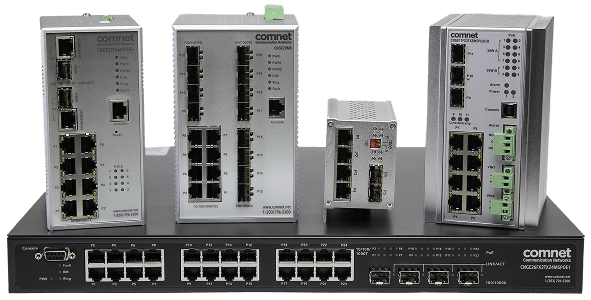
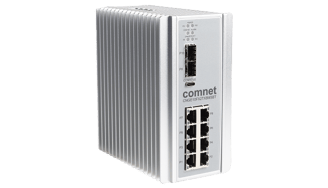
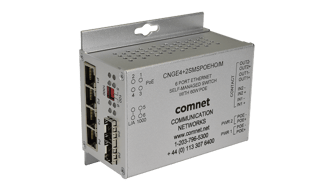
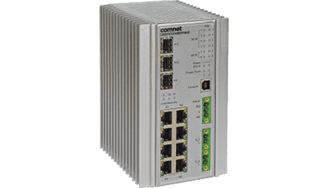
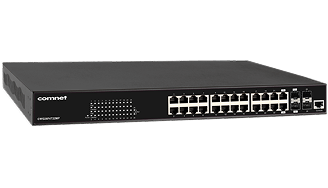
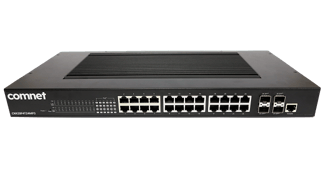
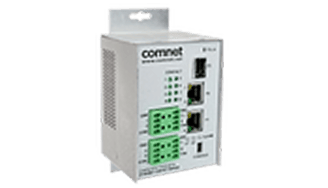
Ethernet Switches
Or select a product below to get
more information
Engineered for Uptime & Security
FAQs
An industrial hardened ethernet switch is a network switch engineered specifically for harsh, unmanned operating environments. Unlike commercial-grade switches, it operates reliably across a wide temperature range of -40°C to +75°C, resists vibration, electromagnetic interference, and humidity, and is typically DIN rail or panel mountable for compact control cabinets. These switches are built with extended mean time between failures (MTBF) to support mission-critical uptime in demanding settings such as factories, transportation systems, utility substations, and outdoor surveillance installations, where a standard commercial switch would fail prematurely.
The core difference is control: a managed industrial ethernet switch can be configured and monitored remotely, while an unmanaged switch is plug-and-play with no configuration. Managed switches give network engineers full configuration control, including VLANs, Quality of Service (QoS) prioritization, SNMP-based remote monitoring, and ring redundancy protocols for network resilience. Unmanaged switches cost less up front, making them well suited to small, fixed network topologies. Managed switches are the right choice whenever network segmentation, remote visibility into switch health, traffic prioritization, or cybersecurity policy enforcement is required, which is why most large industrial and surveillance deployments rely on managed switches.
IEEE 802.3bt, commonly called PoE++, is the newest Power over Ethernet standard and delivers up to 90 watts per port under its Type 4 specification, roughly triple the output of the earlier PoE+ (802.3at) standard. This higher power budget lets a single switch simultaneously power demanding devices (PTZ surveillance cameras, high-output wireless access points, intercoms, digital signage displays, and access control panels) without a separate power supply at each device. For network designers, PoE++ support reduces cabling, eliminates electrical work at remote locations, and simplifies both installation and long-term maintenance.
For IP surveillance deployments, a hardened switch with PoE or PoE++ support is the standard choice, since it delivers both data and power to cameras over a single cable run. Key selection criteria include total PoE power budget for the switch, per-port wattage (30 watts for PoE+, up to 90 watts for PoE++ to support PTZ and multi-sensor cameras), fiber SFP uplinks for connecting distant camera clusters back to a head end, and a wide operating temperature range for outdoor cabinet or rooftop installations. Comnet's PoE and PoE++ switch lines are built to meet all of these requirements.
Intelligent Transportation Systems deployments place switches inside outdoor traffic cabinets, so the switch must be rated for -40°C to +75°C operation and accept wide-voltage DC input from cabinet power supplies. Fiber uplinks are essential for connecting intersection cabinets across long distances, and ring-topology network redundancy protocols prevent a single fiber break from taking down an entire signal corridor. VLAN support separates traffic management data from surveillance camera feeds on the same network, and cybersecurity hardening, including port security and access control, is now a baseline requirement for any switch deployed in public transportation infrastructure.
Yes. Comnet's industrial hardened ethernet switches are rated for continuous operation from -40°C to +75°C, a range designed for outdoor traffic cabinets, roadside enclosures, unconditioned substation control rooms, and factory floors that see severe daily temperature swings. Commercial-grade switches, by comparison, are typically rated only for 0°C to 50°C and are built to operate inside climate-controlled offices or data centers. Deploying a commercial switch outside its rated range shortens its lifespan and increases the risk of failure, which is why field installations depend on switches engineered for these extremes.
DIN rail is a standardized metal mounting rail widely used inside industrial control panels, electrical enclosures, and roadside traffic cabinets. A switch designed for DIN rail mounting snaps directly onto the rail without screws, brackets, or additional hardware, which speeds up initial installation and makes future replacement or troubleshooting far simpler in cramped cabinet spaces. DIN rail compatibility also lets a switch sit alongside other DIN rail-mounted equipment (power supplies, terminal blocks, circuit breakers) in a single, organized enclosure. Most Comnet industrial switches ship with DIN rail mounting as a standard feature.
A Layer 2 switch operates at the data link layer, forwarding traffic based on MAC addresses and supporting VLANs, spanning tree protocols, and basic network segmentation. A Layer 3 switch adds IP routing capability directly into the switch, letting it route traffic between VLANs without a separate router in the path. For most industrial networking and surveillance deployments, a Layer 2 managed switch provides everything required. Layer 3 switches are chosen for larger networks where inter-VLAN routing, more complex segmentation, or reduced reliance on a centralized router is a design priority.
Need Assistance Finding the Right Product?
our communication and security specialists are ready to help.