Network bottlenecks cost infrastructure operators time, money, and reliability. When an access point, IP camera, or industrial sensor connects to an aging Fast Ethernet switch, data transmission crawls at 100 Mbps while modern devices demand 1 Gbps and beyond. For security integrators, utilities, and transportation departments, the choice between Fast Ethernet and gigabit ethernet switches determines whether your network keeps pace with bandwidth-intensive applications or becomes the weak link in your infrastructure.
Gigabit Ethernet switches eliminate that bottleneck. A gigabit switch delivers 10 times the throughput of Fast Ethernet, supporting everything from HD video surveillance to real-time sensor data, all flowing simultaneously across dozens of connected devices. For mission-critical deployments — substations, traffic cabinets, outdoor surveillance networks — an industrial gigabit ethernet switch is no longer optional; it is essential infrastructure.
This guide covers why gigabit switches matter, how managed and unmanaged models compare, which features drive reliability, and which Comnet gigabit ethernet switches deliver the performance and hardening your infrastructure demands.
Note: If you need high-wattage PoE, industrial hardening, or integration with existing fiber infrastructure, our specialists provide technical pre-sale design support and full post-deployment assistance to ensure reliable uptime from day one. Contact Comnet today to discuss your network's demands and get the right switch specification for your infrastructure.
Comnet Gigabit Ethernet Switches for High-Performance Networks
Comnet delivers industrial gigabit ethernet switches engineered for mission-critical deployments. Each model supports wide operating temperatures, comprehensive management features, and gigabit connectivity to handle bandwidth demands without compromise.
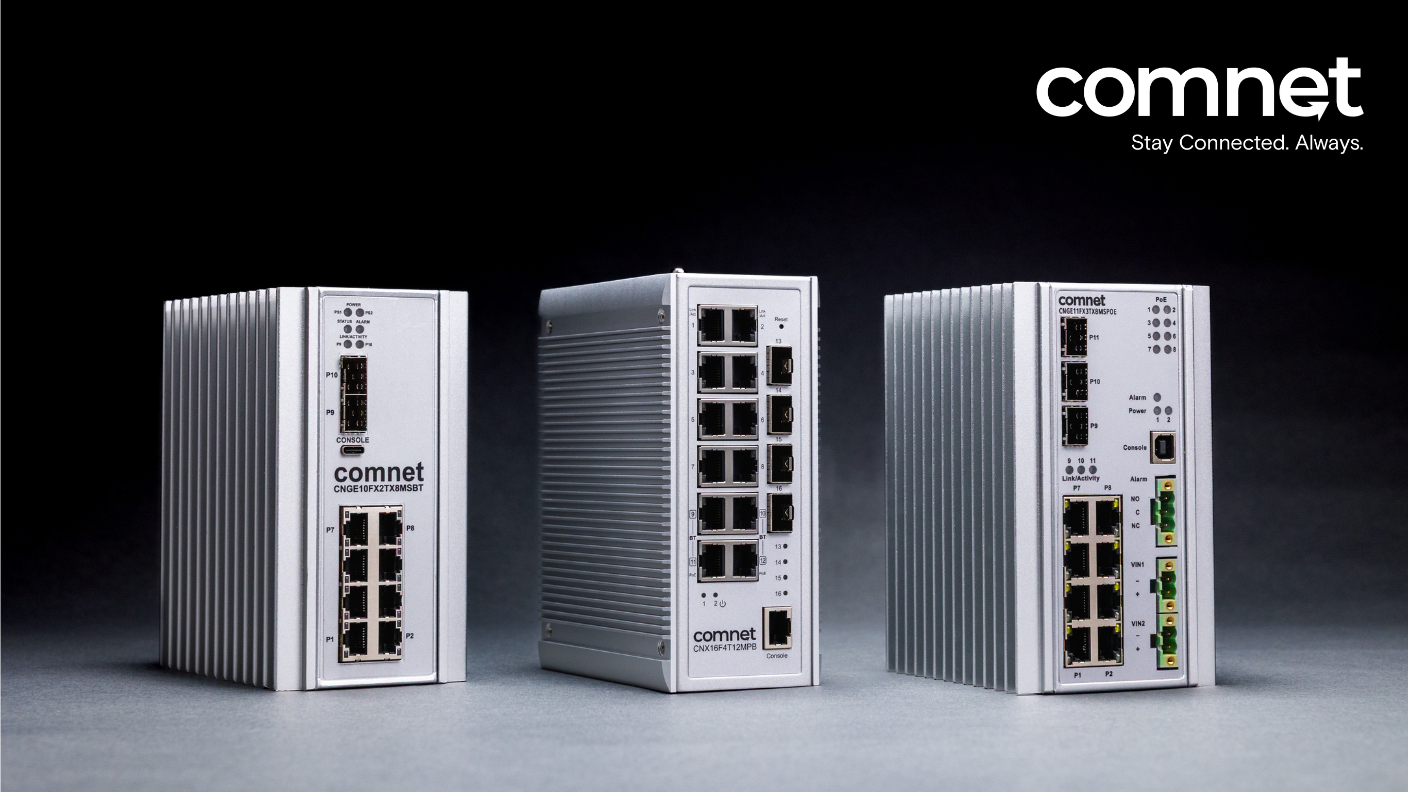
CNGE10FX2TX8MSBT: High-Power PoE Workhorse
The CNGE10FX2TX8MSBT is Comnet's flagship gigabit ethernet switch for power-hungry deployments. It delivers IEEE 802.3bt 90W Power over Ethernet on all eight RJ45 ports simultaneously, for a total PoE budget of 720W. This means eight PTZ cameras, heated enclosures, or wireless access points can draw full power concurrently without pooling or contention.
Two SFP uplink ports support gigabit fiber connectivity at up to 2.5 Gbps, handling high-bandwidth video backhaul or inter-building links. The modular power supply design lets you deploy the switch with the power capacity you need now and upgrade later without replacing the switch itself—a smarter approach to infrastructure that scales with your network.
Operating range of -40 to +75°C, hardened enclosure, DIN-rail mounting, and comprehensive managed features (VLAN, IGMP, C-Ring sub-10ms recovery, SNMP, HTTPS, SSH, IEEE 802.1x) make this gigabit switch ideal for surveillance networks, traffic signal control systems, and utility substations where PoE delivery at scale is the primary challenge.
CNGE2FE8MSPOE+: Compact Industrial PoE Switch
The CNGE2FE8MSPOE+ is a hardened managed gigabit ethernet switch for smaller deployments or edge locations where space is limited. It combines eight 10/100BASE-T(X) ports with IEEE 802.3at PoE+ (30W) and two gigabit SFP or RJ45 combo uplinks. Total PoE budget is 240W, suitable for up to eight standard IP cameras, badge readers, or outdoor sensors.
C-Ring network redundancy delivers recovery under 10ms, protecting applications from network interruptions. Remote monitoring and IGMP snooping support centralized visibility. The -40 to +75°C operating range and compact DIN-rail form factor make this a reliable choice for roadside installations, intersection cabinets, and outdoor security deployments where gigabit speed and PoE are both required.
CNGE20MS: Large-Scale Gigabit Fiber Backbone
For aggregation points and large surveillance or substation networks, the CNGE20MS is a 20-port managed gigabit switch combining eight 10/100/1000BASE-TX electrical ports and twelve 100/1000BASE-FX SFP fiber ports. This configuration supports both copper and fiber connectivity in a single unit, eliminating the need for separate media converters at large deployment sites.
Comnet SFP modules support flexible fiber types—multimode or single-mode, multiple connector standards (LC, SC)—making this gigabit switch adaptable to existing fiber infrastructure. Redundant DC power inputs, C-Ring redundancy, DIN-rail and wall-mount options, and a -40 to +75°C operating range make this ideal for utilities, transportation, and large security networks where gigabit capacity and fiber reach are both critical.
Choosing the Right Gigabit Ethernet Switch for Your Deployment
Evaluating gigabit switches requires matching switch specifications to application requirements. Start with these questions:
How many gigabit ports do you need? Count all devices requiring direct connection. Add growth headroom. A switch with four gigabit ports serves small locations; eight or more ports handle mid-scale deployments; twenty or more ports support large aggregation sites.
Do connected devices require Power over Ethernet PoE? If yes, confirm total wattage at maximum draw, then select a gigabit switch with sufficient PoE budget. IEEE 802.3bt 90W switches handle the highest-power devices; IEEE 802.3at 30W covers standard cameras and sensors.
Will network links exceed 100 meters? If yes, plan for SFP fiber uplinks. Confirm that your gigabit ethernet switch includes SFP ports and that you have the correct SFP module type for your fiber run and distance.
Is the deployment in a harsh environment? If yes—outdoor cabinet, substation, high-EMI area—demand industrial hardening: wide temperature range, vibration resistance, redundant power supply, and NEMA/IEC certifications.
Does the network need management, monitoring, and security enforcement? Managed switches enable remote troubleshooting, VLAN segmentation, access control, and alert notifications. Unmanaged switches are faster to deploy at edge locations but provide no visibility or control.
Connect with Comnet for Your Gigabit Ethernet Switch Deployment
High-performance networks demand gigabit ethernet switches that deliver speed, reliability, and industrial hardening without compromise. Comnet delivers hardened managed switches, PoE solutions, and fiber uplink options proven across security, utility, and transportation deployments worldwide.
Whether you're evaluating a single switch for an edge location or designing a large-scale network backbone, Comnet specialists provide technical pre-sale support and full post-sale assistance. Let's talk about the right gigabit ethernet switch for your infrastructure.
Understanding Gigabit Ethernet vs. Fast Ethernet
Fast Ethernet (100 Mbps) was the industry standard for decades. Modern networks have outpaced it.
Standard Fast Ethernet switches peak at 100 Mbps per port. A single HD video stream consumes 5 to 10 Mbps; add IP cameras, access control systems, and environmental sensors across a substation or traffic cabinet, and that 100 Mbps budget evaporates. Gigabit Ethernet delivers 1,000 Mbps per port, a tenfold speed increase. That difference is not academic; it directly impacts network responsiveness, video frame rates, and the ability to support future growth without replacing core infrastructure.
Gigabit ethernet is also the baseline for modern LAN infrastructure. Access layer switches now support speeds of 1 Gbps and above. For any network where data transmission reliability or multi-device support matters, Fast Ethernet is insufficient. Gigabit switches reduce bottlenecks during large local file transfers and heavy multi-user activity, ensuring consistent performance when it matters most.
The speed advantage compounds when multiple gigabit devices connect to a single switch or when a network backbone aggregates data from many access points. A gigabit switch handles this throughput without degradation.
Managed vs. Unmanaged Gigabit Switches
Not all gigabit ethernet switches are built the same. The choice between managed and unmanaged models fundamentally shapes what you can do with your network.
Unmanaged gigabit switches operate as plug-and-play devices. Connect equipment, and data flows between devices automatically based on MAC address learning. No configuration required. For simple, fixed-topology deployments where all devices are trusted and network visibility is not needed, unmanaged switches offer ease and cost-effectiveness. A basic unmanaged switch with four or eight gigabit ports serves straightforward edge locations where bandwidth is the only concern.
Managed gigabit switches deliver control and visibility. They support VLANs for network segmentation, QoS for traffic prioritization, IGMP snooping to filter multicast streams, port mirroring for diagnostic monitoring, and comprehensive security protocols including SNMPv3, HTTPS, SSH, and IEEE 802.1x port authentication. For any infrastructure where network diagnostics, remote management, or security enforcement is required, a managed switch is mandatory.
Most industrial deployments benefit from a tiered approach: unmanaged models at simple edge locations, managed gigabit switches at aggregation points and locations serving multiple devices or critical functions. Managed switches enable remote troubleshooting, alert operators to faults immediately, and let engineers adapt the network to changing needs without site visits.
Key Features: Power Over Ethernet and Fiber Uplinks
Two capabilities define industrial gigabit switches: Power over Ethernet (PoE) and fiber connectivity.
Power Over Ethernet PoE eliminates separate power supply runs to field devices. A PoE-capable gigabit switch delivers both data and power over a single Ethernet cable, cutting installation time and cost. IEEE 802.3bt PoE (90W per port) powers high-draw devices like PTZ cameras, heated enclosures, and wireless access points. IEEE 802.3at PoE+ (30W per port) covers standard IP cameras and low-power sensors. Always verify total PoE budget against all connected devices at maximum draw before deploying PoE switches.
Fiber uplinks extend network reach beyond copper's 100-meter limit. Most gigabit switches include SFP (Small Form-Factor Pluggable) ports supporting fiber connectivity. Multimode fiber reaches 300 to 500 meters; single-mode fiber extends to 120 kilometers or more. Comnet SFP modules are compatible with the full range of managed and unmanaged switches, offering flexible fiber connectivity without redesigning the network.
Gigabit ethernet uplinks on these fiber modules support bandwidth-intensive backhaul links aggregating multiple video feeds and detection data. When traffic concentrates into a single backbone run, gigabit speed is non-negotiable.
Industrial Hardening: Why It Matters
Commercial gigabit switches are built for climate-controlled data centers. Industrial environments — substations, roadside cabinets, outdoor surveillance enclosures — demand different engineering.
An industrial gigabit ethernet switch operates across wide temperature ranges, typically -40 to +75°C. Hardened enclosures withstand vibration, shock, and high electromagnetic interference (EMI) from nearby power lines and motors. Redundant power supply inputs ensure that a single power failure does not take the switch offline. DIN-rail mounting simplifies cabinet integration. These design choices cost more upfront but prevent costly field failures where replacement parts take weeks to arrive.
For critical infrastructure — utilities, transportation, security — the cost of network downtime far exceeds the premium paid for industrial-grade hardware. An industrial gigabit switch delivers predictable uptime and a measurable return on that investment.
Frequently Asked Questions
Is a 1GB gigabit ethernet switch enough for modern networks?
Yes, for access layer connectivity (IP cameras, sensors, field devices), gigabit Ethernet is the current standard and will remain sufficient for most deployments. However, for aggregation points and backbone links, especially where multiple gigabit devices feed into a single uplink, 2.5G or 10G SFP fiber connectivity becomes valuable for headroom and future growth. Comnet gigabit switches with 2.5G SFP uplinks address this need without the cost of full 10G infrastructure.
What's the difference between a gigabit switch and a network switch?
All switches forward Ethernet data between ports, but "network switch" is a generic term encompassing Fast Ethernet, gigabit, and faster models. A gigabit switch specifically delivers 1 Gbps per port, as opposed to 100 Mbps (Fast Ethernet) or 10 Mbps (older models). For modern networks, gigabit is the baseline standard.
How do I calculate PoE budget for a gigabit switch?
Add the maximum power draw of every connected device. If you have eight 30W IP cameras, that is 240W total. Confirm the switch has at least 240W PoE budget available. Comnet publishes PoE specifications for every model to simplify this calculation. Contact Comnet sales if you need help sizing PoE capacity for your deployment.
Can I mix unmanaged and managed gigabit switches in the same network?
Yes, and it's a common design pattern. Deploy unmanaged switches at simple edge locations where plug-and-play functionality is sufficient. Use managed switches at aggregation points, high-priority locations, or anywhere you need visibility, VLAN segmentation, or redundancy. They operate seamlessly together; the unmanaged switch simply forwards data to the managed switch, which handles routing and policy enforcement. Unmanaged switches should never be placed on a network where multicast traffic is present, self managed / managed switches with IGMP snooping capability should always be deployed throughout.
What's the advantage of industrial hardening for a gigabit switch?
Industrial gigabit switches are engineered for continuous operation in harsh conditions: extreme temperatures, vibration, electromagnetic interference, and outdoor humidity. Commercial switches fail under these stresses. Industrial hardening includes wide temperature range (-40 to +75°C), redundant power supply support, enhanced surge protection, DIN-rail mounting, and certifications for utility and transportation use. This investment pays dividends through reduced unplanned downtime and longer equipment lifespan in mission-critical infrastructure.