by Alex Trace
.png)
Intelligent Transportation Systems rely on communication networks that must perform without interruption. IP cameras at intersections, variable message signs along highways, traffic signal controllers, tunnel sensors — the data transmission linking this equipment has direct safety consequences. Choosing the right industrial Ethernet switch is one of the most critical network decisions an ITS engineer makes. The advantages of purpose-built, industrial-grade hardware over commercial alternatives are clear: greater reliability, secure communication, and availability when it matters most.
This buyer's guide covers what makes an industrial Ethernet switch suitable for ITS, how managed and unmanaged models compare, the key features to evaluate, and which Comnet switches are purpose-built for transportation deployments.
What Is an Industrial Ethernet Switch?
An industrial Ethernet switch is a hardened network device designed for dependable data transmission in harsh environments — extreme temperatures, vibration, shock, and high electromagnetic interference.
Unlike commercial switches built for climate-controlled data centers, an industrial Ethernet switch is engineered for continuous operation at -40 to +75°C across ITS installations: roadside cabinets, tunnels, and outdoor field enclosures. Redundant power supply support, fast-recovery ring protocols, and hardened construction make these switches the correct solution wherever data availability and network uptime are non-negotiable.
Industrial Ethernet switches come in two core types — managed and unmanaged — each offering different levels of network functionality and performance.
Managed and Unmanaged Switches: Understanding the Difference
When specifying an Ethernet switch for an ITS deployment, understanding where managed and unmanaged models each fit is the most important decision affecting long-term reliability and network security.
Layer 2 Managed Switches
Industrial Layer 2 managed switches are designed for extreme temperatures and industrial environments with electromagnetic interference. They support a full range of advanced Ethernet management features — VLAN segmentation, QoS traffic prioritization, port mirroring, multicast filtering, network redundancy protocols, and comprehensive security functions including SNMPv3, HTTPS, SSH, and IEEE 802.1x port-based access control. These capabilities give engineers the ability to configure, monitor, and manage the network remotely.
Managed switches deliver the performance advantages and features that time critical applications in ITS demand: reliable data transmission, ring recovery under 10 milliseconds, and granular access controls across distributed sites. For any ITS node where visibility, control, or network protection is required, managed switches are the correct choice.
Unmanaged Switches
Unmanaged switches operate as plug and play devices — no configuration required. They forward Ethernet data between connected equipment based on MAC address tables with no management interface needed. For simple, fixed-topology edge locations connecting a small number of sensors to an upstream node, these models offer a cost effective solution with easy installation and no specialist setup required.
The limitation of unmanaged models is their lack of network control. You cannot configure VLANs, monitor link status remotely, or enforce security policies. For any ITS deployment where uptime, diagnostics, or security matter, unmanaged hardware is insufficient.
Managed and Unmanaged Switches in a Tiered ITS Network
Most ITS networks benefit from deploying managed and unmanaged switches in complementary roles: unmanaged models at the simplest edge nodes, managed Ethernet switches at every aggregation and high-priority location.
Evaluating managed and unmanaged switches by application — not by price alone — is the correct approach to building secure, scalable transportation infrastructure.
Key Features of an Industrial Ethernet Switch for ITS
Not all industrial Ethernet switches are built the same. For ITS deployments, the right switch needs to deliver on several fronts simultaneously — power delivery, fiber reach, physical form factor, redundancy, and security. Here are the capabilities that matter most when evaluating options for transportation infrastructure.
Power Over Ethernet (PoE)
Power over Ethernet PoE eliminates the need for separate power supply runs to each IP camera, sensor, or access control unit. Industrial PoE switches supporting IEEE 802.3bt (90W per port) handle high-power units like PTZ cameras and heated enclosures; IEEE 802.3at PoE+ (30W) covers standard IP cameras and roadside sensors. Always confirm total PoE budget against all devices connected at maximum draw before specifying PoE switches for a deployment.
The advantages of PoE-capable Ethernet switches are significant in ITS: reduced cabling, simplified installation, and lower cost per connected device. Power over Ethernet PoE reduces both capital expenditure and installation time across large transportation deployments.
Gigabit Ethernet and Transmission Speeds
Backhaul links aggregating multiple video feeds and detection data require gigabit Ethernet as a minimum standard. Gigabit Ethernet uplinks prevent bottlenecks where fast Ethernet access ports converge into a single backbone run. For high-density surveillance corridors, 2.5G SFP uplinks provide additional transmission speed headroom. Fast Ethernet (100 Mbps) remains suitable for individual sensors and low-bandwidth field hardware.
Fiber Optic Cables, SFP Modules, and Fiber Connectivity
Runs between ITS nodes frequently exceed the 100-meter limit of copper Ethernet cable. Fiber optic cables carry data transmission over much greater distances and provide electrical isolation near high-voltage roadside equipment. SFP transceivers support flexible fiber connectivity on managed switches, with multimode and single-mode fiber optic cables, LC or SC connectors, and distances from 300 meters to 120 kilometers. Comnet SFP modules are compatible with Comnet's full range of managed and unmanaged switches and media converters.
DIN-Rail Mounting, Control Cabinet Integration, and Space
DIN-rail mounting is the industry standard for ITS cabinet hardware. Switches with DIN-rail support install cleanly on 35mm rail inside a control cabinet, saving space and simplifying field installation. Some Comnet Ethernet switches are also designed specifically for NEMA TS2 traffic detector rack integration, deriving power from the backplane — a fully integrated, compact installation with no additional connectors or power supply wiring required inside the cabinet.
Redundant Power Supply and Alarm Relay
A power supply failure should not take a roadside switch offline. ITS Ethernet switches should accept redundant power from two independent inputs. A dedicated fault notification output — the alarm relay — signals operators immediately when a power loss, link failure, or temperature threshold is exceeded, supporting proactive service and improving network availability.
Security, Protocols, and Communication
ITS networks are increasingly classified as critical infrastructures, and their protection requirements reflect this. Switches for transportation deployments must support comprehensive security functions: HTTPS, SSH, IEEE 802.1x, and TACACS+ to prevent unauthorized network access.
Disabling unused ports reduces the attack surface at roadside locations. IGMP snooping prevents multicast video data from flooding links where it is not needed. Modbus TCP support enables integration with industrial control and monitoring software across transportation systems. These protocols ensure each switch is a secure, well-integrated communication node serving every industrial network deployment.
Comnet Industrial Ethernet Switches for ITS
Comnet's industrial Ethernet switch range meets NEMA TS-1/TS-2 environmental requirements and the Caltrans specification for traffic signal control equipment — purpose-built for the performance, reliability, and communication demands of ITS industrial networks.
CNGE2FE8MSPOE+ — Hardened Managed PoE Switch
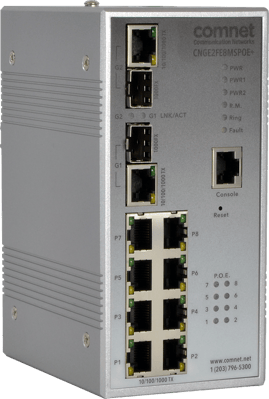
The CNGE2FE8MSPOE+ is a hardened managed Ethernet switch with IEEE 802.3at PoE+ across eight 10/100BASE-T(X) data ports and two gigabit SFP or RJ-45 combo uplinks, with up to 240W total PoE budget distributed across all TX ports. C-Ring network redundancy delivers recovery under 10ms. Remote monitoring, IGMP snooping, and a -40 to +75°C operating range make this a reliable, integrated solution for roadside and intersection deployments serving multiple field devices.
CNGE10FX2TX8MSBT — 720W Industrial PoE Switch
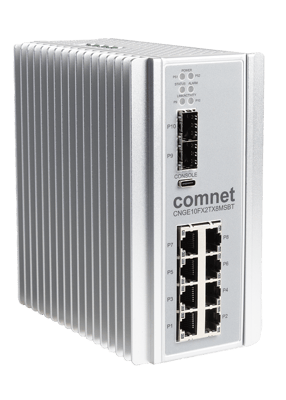
The CNGE10FX2TX8MSBT delivers IEEE 802.3bt 90W Power over Ethernet PoE simultaneously across all eight RJ45 ports — 720W total PoE budget — with two SFP ports supporting fiber connectivity at up to 2.5 Gbps. Its modular power supply design lets operators scale power delivery without replacing the switch, making it a cost effective choice for phased ITS buildouts where devices may be added progressively.
CNG6F2T4MPB — Compact Hardened Switch with PoE and Alarm Output
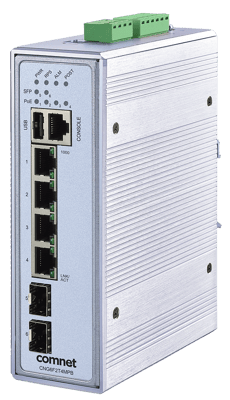
The CNG6F2T4MPB offers four IEEE 802.3bt 90W PoE copper ports (360W total PoE budget) and two 1G SFP fiber uplinks. Redundant power supply inputs, two digital inputs, and an alarm relay output are integrated into a compact DIN rail form factor suited to traffic cabinets with limited room. Comprehensive security functions — SNMPv3, HTTPS, SSH, TACACS+, and IEEE 802.1x — and a -40 to +75°C operating range make this the best choice for deployments requiring high-wattage Power over Ethernet PoE and advanced protection in a single industrial Ethernet switch.
CNGE5MS — NEMA TS2 Rack-Compatible Managed Switch
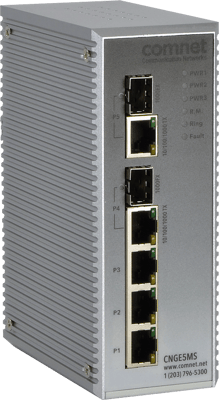
The CNGE5MS is a hardened five-port all-gigabit managed Ethernet switch with three 10/100/1000Base-TX ports and two gigabit SFP combo ports. Designed to fit directly into a NEMA TS2 traffic detector rack, it derives power from the backplane — eliminating a separate power supply and additional connectors inside the cabinet. It is the most space-efficient integrated solution for integrators standardizing ITS deployments in traffic control cabinets.
Frequently Asked Questions
What makes an industrial Ethernet switch suitable for ITS?
Hardened Ethernet switches are designed for wide temperature ranges, vibration, and electromagnetic interference found in ITS industrial environments. They support redundant power supply inputs, DIN rail mounting, fast-recovery ring protocols, and communication protocols not available on commercial plug and play devices. For ITS and other critical infrastructures, these switches deliver the reliability and service life the industry requires.
Do ITS deployments need managed or unmanaged switches?
Most ITS nodes require managed switches. The full functionality of managed Ethernet switches — network monitoring, VLAN configuration, QoS, and redundancy protocols — is not available in unmanaged models. Managed and unmanaged switches can coexist in a tiered ITS network, with unmanaged models at simple edge locations and managed hardware at every aggregation node. The performance advantages of managed switches become most apparent when faults must be diagnosed remotely or when data prioritization is required.
How does Power over Ethernet PoE simplify ITS deployments?
PoE-capable industrial Ethernet switches deliver both data and power over a single Ethernet cable, eliminating separate power supply runs to each field device. This reduces installation time, simplifies cable management, and lowers the total cost of connecting devices across a transportation network. IEEE 802.3bt switches supporting up to 90W per port cover even the highest-power ITS devices.
Related Posts

EdgeReset™: The End of the Truck Roll for Routine Device Resets
Fewer site visits. Faster recovery. Ask any network operations team what their most frustrating recurring unnecessary use of resources is, and "truck rolls for power cycles" will come up fast. A camera locks up. An access control panel stops responding. A sensor goes dark. In almost every case, the fix is simple - turn it off, turn it on - but getting a technician to the device to do it is anything but simple.

The Media Converter Built to Reduce Site Visits
Built for the field. Smarter when you need it. Media converters don't get much attention — until one fails in a traffic cabinet at 2 a.m. during a snowstorm, or overheats in a substation enclosure in August. For network engineers and integrators specifying equipment for critical infrastructure, the media converter is often the weakest link in an otherwise well-designed system: a commercial-grade component asked to do an industrial-grade job.
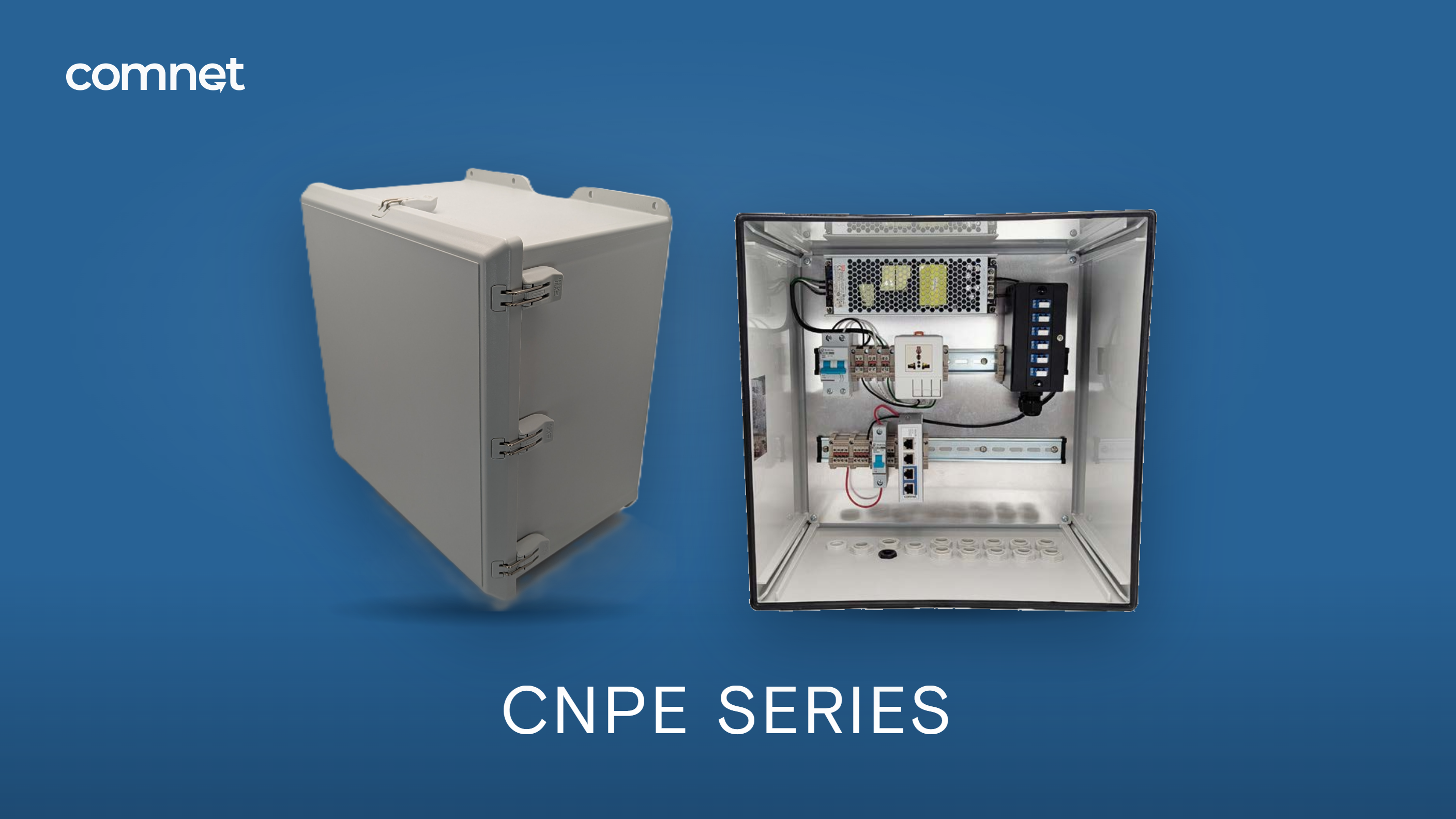
No Enclosure to Build: Inside Comnet's Pre-Configured CNPE Series
Every outdoor network deployment starts with the same short list of problems: how do you power the device, how do you protect it from the environment, and how do you connect it back to the network. Historically, that meant sourcing an enclosure, a power supply, circuit breakers, surge protection, and cable management separately, then building the whole thing in-house before it ever reached the field.