A traffic cabinet in July, a substation full of electrical noise, a perimeter camera line that cannot drop frames. These are the places where switch brand choice stops being a line item and starts being a risk decision. TRENDnet and Comnet both sell managed switches, PoE gear, and fiber products, but they are built for very different networks. This guide compares them using specifications published on each brand's own website.
Note: If your network runs through substations, traffic cabinets, or outdoor camera lines where a dropped link means lost data, then Comnet’s hardened switches give you substation-rated builds and C-Ring recovery in under 30 ms, so a failed link doesn’t take your system down with it. Made in USA options, NDAA and TAA compliance, and a limited lifetime warranty on most products means you’re not stuck choosing between uptime and procurement requirements. Talk to the Comnet team to spec a network built for the conditions it will actually face.
The Short Answer: Comnet for Mission-Critical, TRENDnet for Budget Commercial
If the network carries surveillance video, substation data, or traffic control signals, Comnet is the stronger fit. Select Comnet switches meet substation and transportation certifications, support Comnet's C-Ring fast-recovery protocol, and include Made in USA models, most backed by a limited lifetime warranty. TRENDnet is a solid choice for offices, retail, and light industrial projects where price per port matters most.
|
Capability
|
TRENDnet
|
Comnet
|
|
Founded / HQ
|
1990, Torrance, California
|
2008, Danbury, Connecticut
|
|
Core market
|
SMB and home office
|
Transportation, utilities, manufacturing, security
|
|
Substation and traffic ratings
|
Not listed on reviewed industrial models
|
IEC 61850-3, IEEE 1613, NEMA TS-1/TS-2 on select models
|
|
Ring redundancy
|
ERPS G.8032, STP/RSTP
|
C-Ring (under 30 ms, 250+ switches), ERPS, MSTP
|
|
Max PoE per port
|
Up to 90W, 360w budget
|
90W 802.3bt on all 8 ports, 720W budget
|
|
Made in USA
|
Not stated
|
Yes, on select models
|
Who Is Comnet?
Comnet, part of Acre Security, was founded in 2008 in Danbury, Connecticut by a team with deep roots in fiber optic transmission. Instead of covering every networking category, Comnet focuses on industrial networking for intelligent transportation, power and utility, manufacturing, and security and surveillance. Its products are designed to handle extreme temperatures, high EMI, vibration, and voltage spikes in substations, outdoor surveillance sites, and roadside cabinets.
Who Is TRENDnet?
What country is TRENDnet from? TRENDnet is an American company, founded in 1990 and headquartered in Torrance, California. Its official positioning targets small and medium-sized businesses and home office users. The catalog is broad, with gigabit Ethernet and multi-gigabit options: unmanaged, smart managed, and Layer 2 managed switches, plus routers, access points, IP cameras, NVRs, KVM switches, patch panels, and USB accessories.
Is TRENDnet a good brand? For commercial networks, yes. It holds ISO 9001:2015 certification and offers TRENDnet Hive, a cloud management service for remote monitoring (an additional fee applies). Its strength is price-to-performance value for wired and wireless gear. Learn more here.
Head-to-Head Comparison
The differences show up most clearly in five areas.
Environmental Hardening and Certifications
TRENDnet's industrial managed switches, such as the TI-G160i, operate from -40°C to 75°C and carry CE, FCC, and IEC 60068 shock and vibration certifications. That is respectable for factory floors and indoor cabinets.
Comnet goes further for substations and traffic cabinets. Its substation-rated managed switches are built to the requirements of IEC 61850-3 and IEEE 1613 Class 2 for utility substations and NEMA TS-1/TS-2 for traffic signal equipment, and they also meet EN50155 for rail. TRENDnet also offers EN50155 railway switches, so rail alone is not the differentiator; the gap is substation and traffic-signal standards. If your specification calls for any of those standards, ask Comnet for the certification documentation for your specific model.
Network Redundancy and Ring Recovery
Both brands support standard Spanning Tree, and TRENDnet's managed industrial switches add ERPS. Comnet adds its own C-Ring protocol, which recovers in under 30 ms with more than 250 switches in a single ring on models such as the RLGE20FX4TX16MS, alongside C-Chain for multiple redundant rings. For a video management system recording a fence line, sub-30 ms ring recovery keeps the gap in footage short when a link fails.
PoE Power for Cameras and Access Control
TRENDnet offers PoE, PoE+, and PoE++ across switches and injectors, including industrial 802.3bt switches such as the TI-BG62i, which delivers up to 90W on four ports with a 360W budget. Comnet’s hardened managed PoE switch doubles that: 90W 802.3bt power on all 8 ports at once, with a 720W PoE budget across its full operating temperature range. Full power in heat is what PTZ cameras with heaters need in an outdoor cabinet.
Management, Monitoring, and Security Features
TRENDnet managed switches support virtual local area networks, QoS, SNMP, IGMP snooping, and 802.1X, and users can manage them through a local web interface or TRENDnet Hive. Comnet managed switches cover the same core features, and its Layer 3 switches add dynamic routing between network segments. Comnet also offers application engineers and technical support for system design.
Compliance, Made in USA, and Warranty
Both brands sell NDAA and TAA compliant products. Comnet adds Made in USA models, and its 90W PoE switch is also Build America, Buy America (BABA) compliant. On warranty, TRENDnet offers a limited lifetime warranty on metal-enclosed switches bought in the US and Canada, but only two years on industrial mini switches. Comnet backs its products with a limited lifetime warranty. Read more in Comnet's Made in the USA advantage.
Comnet Products Worth Shortlisting
These Comnet categories map directly to the jobs where TRENDnet's commercial focus runs out.
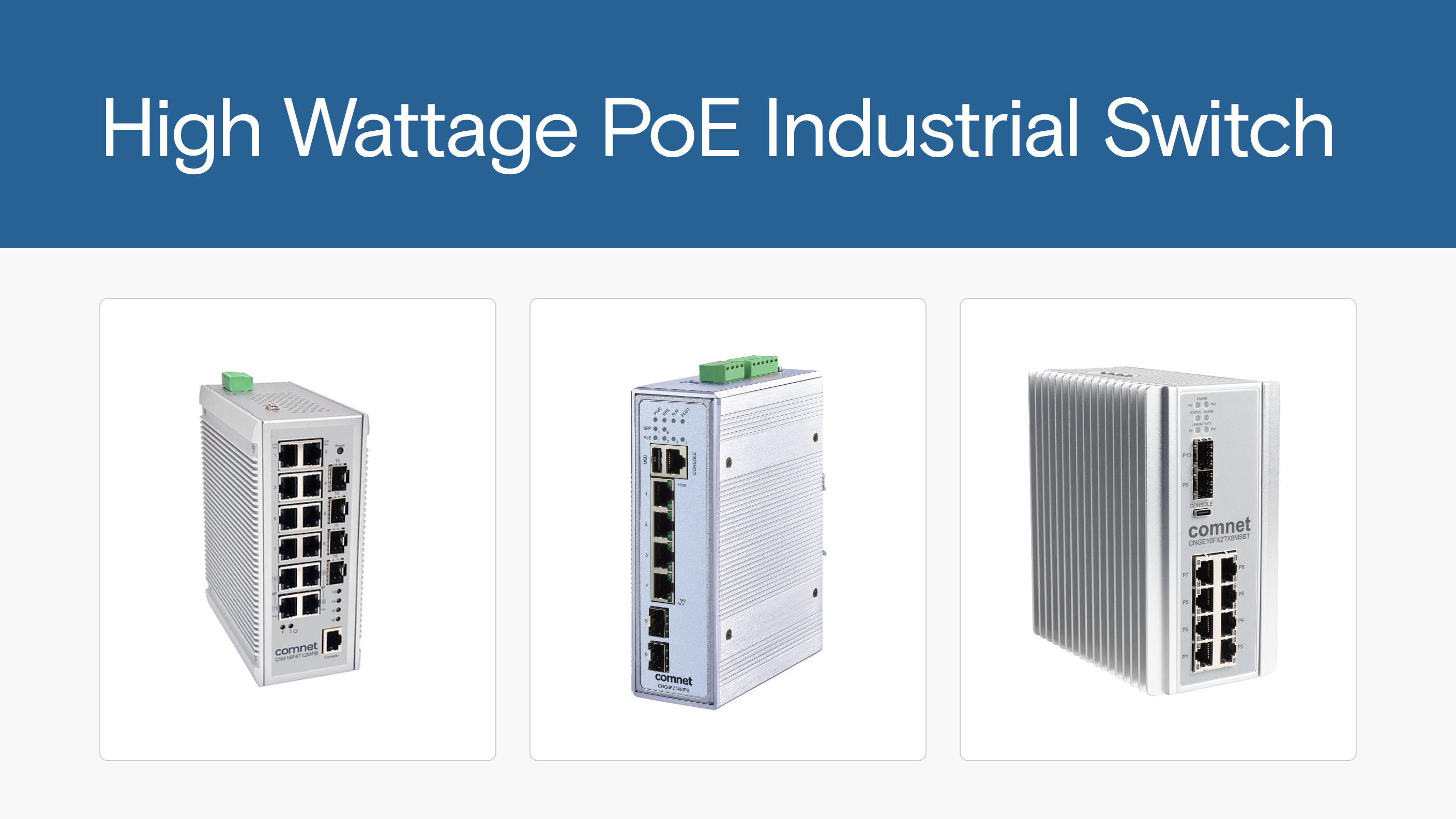
Hardened Managed PoE Switch (CNGE10FX2TX8MSBT)
Eight 90W PoE ports, two 2.5G SFP uplinks, and a 720W budget. It is Made in USA and BABA, TAA, and NDAA compliant. (See CNGE10FX2TX8MSBT)
Substation-Rated Managed Switch (RLGE20FX4TX16MS)
The RLGE20FX4TX16MS has sixteen gigabit Ethernet ports and four SFP combo ports, with redundant DC inputs and C-Ring support. Built for substations, rail, and traffic cabinets. For compliance context, see our guide to NERC CIP.
Industrial Ethernet Switches
Managed and unmanaged industrial hardened switches, PoE switches, commercial grade switches, Layer 3 switches, and terminal servers. See more ethernet switches here.
Media Converters
Substation-rated and PoE-capable media converters for copper-to-fiber transitions. The hardened smart media converter with 90W PoE is built to reduce site visits.
Network Extenders
Copper extended Ethernet, Ethernet repeaters, and wireless Ethernet for sites where new cabling is not practical. View all of Comnet’s network extenders.
Managed vs Unmanaged Switches: Which Does Your Project Need?
Unmanaged switches are plug-and-play network switches with no configuration. They are less expensive and ideal for a few desktop devices that just need to connect. Smart managed switches add basic VLAN and QoS settings through a simple web interface. Fully managed switches let you configure VLANs, monitor port health with SNMP, set access controls, and detect faults remotely.
For security and OT networks, managed switches are the right choice. Segmentation and monitoring are basic requirements, not advanced features.
Why Ethernet Hubs Are Obsolete
A hub repeats every frame to every port, so all connected devices share one collision domain and one slice of bandwidth. A switch learns MAC addresses and forwards each frame only to the port that needs it, with full-duplex speed per port. The benefit of a switch over a hub is better performance, less wasted traffic, and basic security, which is why switches replaced hubs entirely.
Where Netgear and TP-Link Fit
Readers comparing TRENDnet vs Netgear or TP-Link are usually shopping in the same SMB category. A Netgear switch or TP-Link switch competes with TRENDnet on price, cloud management, and easy setup for office network switches. Netgear and TP-Link are each other's main competitors in that space. None of them is built around substation, rail, or traffic cabinet certifications, which is where Comnet operates.
Which Brand Network Switch Is Best?
The best brand depends on the environment. For an office, retail store, or indoor camera system on a tight budget, TRENDnet delivers reliable value. For utilities, transportation, defense-adjacent sites, and outdoor security where uptime and compliance are mandatory, Comnet is the better choice.
If your next project cannot afford downtime, contact Comnet to spec hardened switches built for it.